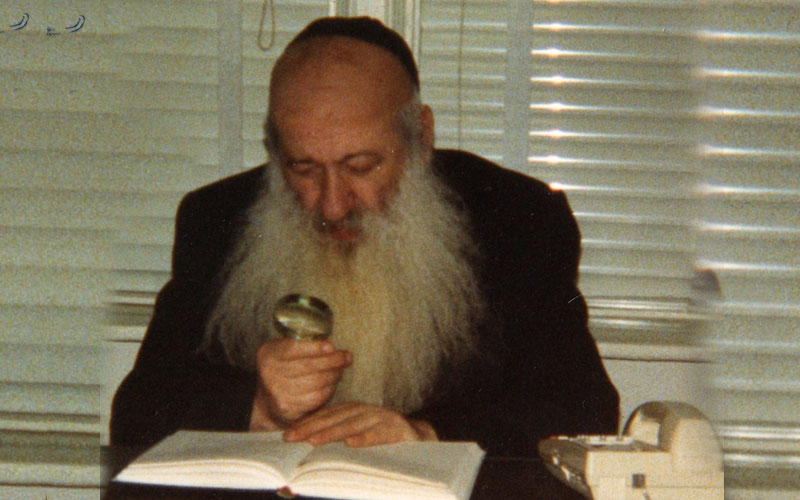
HaRav Avrohom Karp ZT"L
A Chossid all his life: born to Trisker Chassidim in Frampol, he learned in the great yeshivos of Navardok and Kletzk, kept his Yiddishkeit whole through the Siberian camps, and in Montreal made his home in Lubavitch. Honored by gedolim of every circle, he was a beloved mechanech, and for over thirty years gave the Daf Yomi shiur in the Lubavitcher Yeshiva, the shiur you can hear on this site.
His life
A Chassidishe home in Frampol
Reb Avrohom was born on Tes-Vov Teves, 5682, in Frampol, Poland, to Reb Yaakov Boruch and Rochel Karp, a family of Trisker Chassidim. Frampol was not far from Lublin, and his father also travelled to Reb Moishe'le of Lublin. Reb Yaakov Boruch was a talmid chochom, a shochet, bodek and mohel, who at times sat on a Beis Din with the Bilgorayer Rav, Reb Mordche Rokeach, the son of the Belzer Rebbe. Reb Avrohom remembered his father poring over the Tur and Shulchan Oruch every morning before davening.
He was the third youngest of eleven children, and like the other children of the town he learned in shul with a melamed, who taught each child at his own level.
Away to yeshiva
Already as a young boy he had a deep thirst for Torah. At ten or eleven, he and his brother Toviya went off to learn in the yeshiva of Navardok. His father knew his sons could not grow to their full potential in a small village, and made the sacrifice of sending them away. The yeshiva's ways were very different from the Chassidishe home he came from, yet he thrived there; his hasmodoh knew no bounds, and he was often found learning long after the set hours.
When he became bar mitzvah he did not even feel the need to go home for it: taking on the yoke of mitzvos was joy enough. His father sent a pair of tefillin to the yeshiva, and that was the whole celebration. When he did come home, he sent word ahead through a sister, and his mother sent him a chalat, so that he would greet his father dressed in the family's Chassidishe way and not in the short jacket of the yeshiva bochurim.
Kletzk
He went on to the great yeshiva of Kletzk. His father worried about sending him so far, but an uncle who saw his longing to grow helped him go and sent him pocket money. There he was known as "Avremele der masmid," and he became a friend of the future Rosh Yeshiva, Rav Shneur Kotler zt"l.
As his first Pesach in Kletzk approached, he worried that he would not be able to say Hallel in shul on the night of Pesach, as was his Chassidishe minhag. Then he heard that bochurim came back to say it after the minyan, and to his surprise most of them did. Reb Avrohom would later say that most of the bochurim in Kletzk came from Chassidishe homes. He learned in the Litvishe yeshivos with all his heart, and took from them a love of deep, clear learning, but he remained a Chossid: the warmth, the minhagim and the yiras shomayim of his Chassidishe home went with him through all his years in yeshiva, and all his life.
He rarely spoke of those years. One thing he did tell was how shy he had been. On one Purim there was no food in the yeshiva kitchen, and rather than go to a stranger's home he scraped together a kezayis from the counters. Afterwards he wondered whether he could make a brocha achrona, not knowing whether he had eaten food or chips of wood.
Mesiras nefesh in Siberia
The war ended those years abruptly. Like many, he fled to Vilna; there he was caught by the Soviets and sent to a labor camp in Siberia. He would not let non-kosher food pass his lips, and he ate so little that he became too weak to leave his bed. A Jew in the area, seeing his state, began preparing kosher food for him, and slowly he regained his strength.
Once he was ordered to drive a tractor on Shabbos. Before Shabbos he poured a cup of sugar into its fuel tank; the motor broke, and Shabbos stayed holy.
One story he always told with great emotion. In Siberia he stayed with an old Yiddishe bobbe, and two weeks before Pesach he heard her counting Sefira. She had no calendar and had counted from the year before, not knowing it was a leap year. All winter she had saved potatoes so that she could eat without chometz on Pesach, and now she banged on the table and cried that she had eaten them up too soon. He always stressed her piety: alone, with no other Yidden, not even knowing the true date of Yom Tov, she had gone without food all winter for its sake.
Rebuilding, and Lubavitch
After the war he slowly took in that his parents had stayed under German rule and been murdered al kiddush Hashem; some of his older siblings, who had fled to Russia, survived. When he first sat down with a Mishnayos, he found that he could not understand it. Never one to give up, he resolved to immerse himself in learning until it all came back, and it did.
In the DP camp at Pocking he found himself among bochurim of Tomchei Temimim, and there he came to know Lubavitch for the first time. As a young bochur, he said, the only thing he had heard about Lubavitch was that the Rebbe Rashab had come to Warsaw.
He went on to France, where he became a marbitz Torah in the yeshiva at Bailly, founded by talmidim of Navardok, mostly for boys who had spent the war in Morocco. He threw himself into rescuing Jewish children who had been hidden with non-Jewish families and lost their parents, settling them in homes where they could recover, and often raising the money for it himself.
In the summer of 1949 the Bilgorayer Rav came to France. Reb Avrohom asked to see him, and when told the Rav was resting, asked only that the gabbai say that "Yaakov Boruch der shochet's son" was here. Before he reached the bottom of the stairs, he was called back. He had one question that gave him no rest: why had the tzaddikim told people to stay in Poland? The Bilgorayer Rav had asked his brother, the Belzer Rebbe, the same question, and repeated his answer:
"V'anochi haster astir: sometimes the Aibershter hides even from the tzaddikim."The present Belzer Rebbe has retold this conversation between his father and Reb Avrohom many times.
Marriage and Montreal
In Paris he was introduced to Rivka Slavin, daughter of Reb Zev Volf Slavin, who had become a devoted Lubavitcher Chossid after the war. Reb Mendel Morozow liked to tell how Reb Zev Volf invited him to his new son-in-law's aufruf; he walked an hour to share his friend's simcha without even knowing who the chosson was, and when he saw him, recognized him from Pocking and exclaimed, "What a catch you got: a talmid chochom, and very frum!" They married on 11 Tishrei 5712, with no family of his own there to see it.
Before leaving Paris, Reb Avrohom went to take leave of the Pshevorsker Rebbe, Reb Itzikel, who walked him from his second-floor apartment all the way down to the street, something those close to Reb Itzikel had never seen. The young couple followed her parents to Montreal. His mother-in-law later lived with them until her last days, and the respect he showed her was remembered by all: if every husband respected his wife the way he respected his mother-in-law, his wife used to say, the world would be a different place.
A melamed with his whole heart
In Montreal a wealthy man set him up in business. He was successful, but soon stopped: he would rather be a melamed, and he never wanted to be rich. He took a position in the Klausenburger Mesivta, Reishis Chochmah, teaching young children Alef-Beis, and gave it all his heart. He was the first to make Alef-Beis cards and charts, asking a sofer to draw large letters with nekudos, and he brought a bottle of milk to school each morning so that the children would be well fed and able to learn.
In 1963, when the Rosh Yeshiva, Rav Shmuel Unsdorfer zt"l, went to Eretz Yisroel for an extended time, he appointed Reb Avrohom mashgiach and maggid shiur for the senior bochurim. He also taught in the Lubavitcher Yeshiva.
He came to yeshiva at six in the morning to help any bochur who needed it, and taught into the evening. He could make the hardest sugya clear to an average bochur. Asked how, he said: "It takes a lot of hard work to make something easy." He never hit and never shouted, and every bochur felt that his rebbi wanted him to succeed. He gave a tape recorder to any talmid who reached his fourteenth birthday never having spoken while wearing tefillin, picture cards to boys who came fifteen minutes early, and watches to those who learned masechtos by heart. Every Sunday he tested the bochurim on the parsha's Rashis. Thirty years later his talmidim still came to see him on Chol HaMoed, as one visits his rebbi on Yom Tov, now asking about their own children.
A Chossid in Lubavitch
Reb Avrohom was a Chossid. The Trisker Chossid's son who had first met Lubavitch among the Tomchei Temimim bochurim in Pocking, married into a Lubavitcher home, and in Montreal Lubavitch became his home. He always davened in the Lubavitcher shul, at a place in the middle of the shul, away from honor. His tefillos were quiet, yet every word could be heard, and he never made a brocha without his hat. The Rebbe said of him:
"ער איז איבערגעגעבן און מיינט מיט אן אמת"He is totally devoted, and totally sincere.
He gave many bar mitzvah boys a sefer to learn from, very often a Tanya. He urged his talmidim, and everyone, to learn the Alter Rebbe's Shulchan Aruch, and bought copies with his own money so that more people would have one. To a talmid going to learn in America he said, "You're in America: go to a farbrengen." The bochur went, and remembers that farbrengen to this day. When someone tried to show him a flaw in Chabad, he answered:
"א גאלדענע כלי, אפילו ווען עס האט א שפאלט, ווארפט מען עס נישט אוועק"A golden vessel, even if it has a crack, is not thrown away.
Honored by gedolim of every circle
Though he was a Chossid through and through, gedolim of every kind held him in high esteem.
The Bilgorayer Rav, Reb Mordche Rokeach, called him back up the stairs when he heard "Yaakov Boruch der shochet's son" was at the door, asked how he had survived and who was left of his family, and invited him to stay over where he was lodging in Paris. His son, the Belzer Rebbe, Reb Yissachar Dov, kept the account of their conversation on his desk for more than a year and has retold it many times.The Pshevorsker Rebbe, Reb Itzikel, an elderly man, walked him from his second-floor apartment down to the street when he came to take leave before Montreal, an honor those around the Rebbe had never seen him give.In Kletzk he became a friend of HaGaon Rav Shneur Kotler. In Montreal, Rav Shmuel Unsdorfer, the Klausenburger Rosh Yeshiva, chose him as mashgiach and maggid shiur and met with him every few weeks to talk over each bochur.
On trips to New York for a farbrengen, he always visited HaGaon Rav Yitzchok Hutner, in whose yeshiva his orphaned nephew learned; Reb Avrohom raised that nephew from afar like his own son and paid his tuition. Once, around Yud Shevat, Rav Hutner asked him how he could take on such a burden. "A Yid darf zich onshtrengen," he answered: a Jew must exert himself. A week later, unwell and with a broken leg, Rav Hutner pushed himself to attend a melave malka for a certain Rebbe, and his driver heard him murmuring all the way, "A Yid darf zich onshtrengen." Rav Hutner later said: "He said it with such simplicity that it went through all my bones."
When the posek hador, HaGaon Rav Moshe Feinstein, visited Montreal, Reb Avrohom spoke up at a reception about chinuch: how could the townspeople be expected to send their children to yeshiva when even some rabbis sent theirs to public school? Reb Moshe saw his sincerity and answered, "If I stay another day, can it be accomplished?" Reb Avrohom told the story to show Reb Moshe's humility.
HaGaon Rav Pinchas Hirschprung, the Rav of Montreal, was a close friend. Once, waiting together at a bus stop, Reb Avrohom suggested they go through all the Tosafos of Maseches Makos by their opening words, each saying the next, and so they did.And the Rebbe said of him: "Er iz ibergegeben, un meint mit an emes."
He returned that respect to everyone who learned. He honored a quiet Yid who stood at the back of the Lubavitcher shul, because "the gedolim valued his opinion before the war"; he was in awe of the clear understanding of Reb Yitzchok Petrushka, a shochet in the shiur, and said Reb Yitzchok should be giving it instead of him; and at the library of Mr. Yaakov Lowy, when he found the first printing of Rashi on the Torah and in minutes answered questions he had carried for years, he spoke of it as a great event.
Torah for everyone
Besides the yeshivos, he gave shiurim all over Montreal: a daily Mishnayos shiur between Mincha and Maariv at the Young Israel, a Chumash-Rashi shiur at the old-age home ("Gemara, many can teach, but in a Chumash-Rashi shiur I really sweat"), and weekly shiurim in homes. At one Shabbos shiur in the home of a prominent family, he always left as soon as he finished, before the tea was served; his place, he told his young son, was learning, not sitting with the leaders. They respected him all the more for it.
Nothing was too small. In his last years, an elderly Russian Jew came to him to learn the nekudos. When a visiting talmid asked whether someone else could not do it, he answered: "Who says that learning nekudos with a Yid is less important than teaching Gemara and Tosafos to baalei batim?"
The Daf Yomi shiur
The crown of all his shiurim began with a call to the pay phone. Reb Moshe Elya Gerlitzky, the gabbai of the Lubavitcher shul, told him that a new cycle of Daf Yomi was beginning and asked him to give the shiur in the Lubavitcher Yeshiva. For over thirty years he did, going through Shas nearly four times without skipping a line. Reb Naftali Junik, the shochet who had pressed to start the shiur, went into yechidus and asked the Rebbe for a bracha that it should succeed; the Rebbe smiled and asked, "Is that all?"
Every night at least 25 people came, and often more than 50, many of them talmidei chachomim: shochtim, rabbonim of the city's larger shuls, professors from McGill and the Université de Montréal, alongside the baalei batim. Reb Peretz Mochkin, the mashpia of the Lubavitch community, learned each daf before coming, to enjoy how Reb Avrohom explained it. When Reb Peretz went into yechidus and asked the Rebbe for a bracha for the shiur, the Rebbe told him that he had not heard about Daf Yomi from his father-in-law, the Frierdiker Rebbe, so he should ask for a bracha for the shiur. And when the shiur came to a siyum haShas and asked whether the city's siyum should be held there, the Rebbe circled "Lubavitch" and wrote: "כפשוט. אזכיר על הציון."
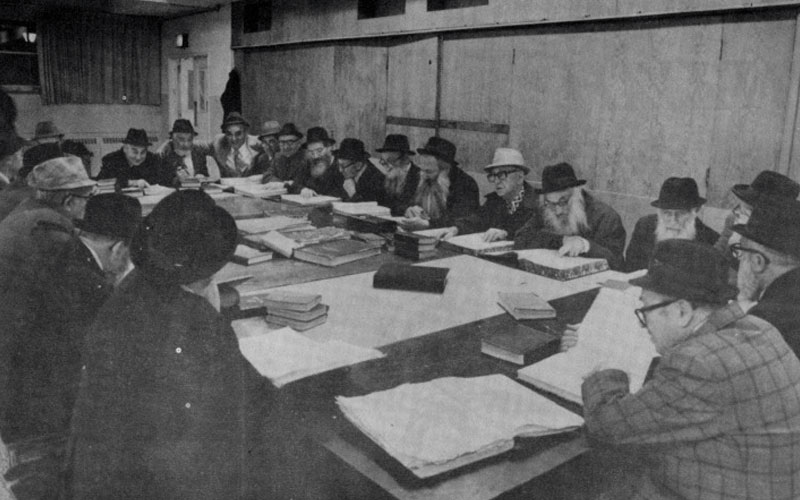
The Daf Yomi shiur in Montreal.
Such listeners called for preparation: a few hours every day, ten hours over Shabbos, and all of Thursday night, from ten in the evening until six in the morning, with eight cups of coffee. First he learned the week's seven dapim through until he could say them by heart, then went through his index cards of questions still open. "First you have to know the whole picture." His wife would joke that they had promised her a great lamdan, "but all I hear is: I can't eat supper, I don't know the Gemara yet; say Tehillim for me, I'm not ready for the shiur!" Once he told his son, "Today is Yom Tov by me, but don't tell anyone": he had gone to sleep stuck on a Gemara, and the answer had come to him in a dream.
He never missed a shiur. On the night of a record Montreal blizzard, his wife said not even a dog would go out; he went anyway: "Maybe someone will come." Three men came, "because we knew he would be here." In twelve years he was once five minutes late, and apologized again and again. On winter Motzoei Shabbos the shiur was followed by a melave malka, with a story of the Baal Shem Tov and niggunim.
"Zogt di Gemoro! Tani Reb Chiya..."His booming yet gentle Yiddish carried the warmth of Chassidishe Poland, the learning of Lita, and often the tune of a Chabad maamar, so that every listener felt he was hearing someone "fun der heim."
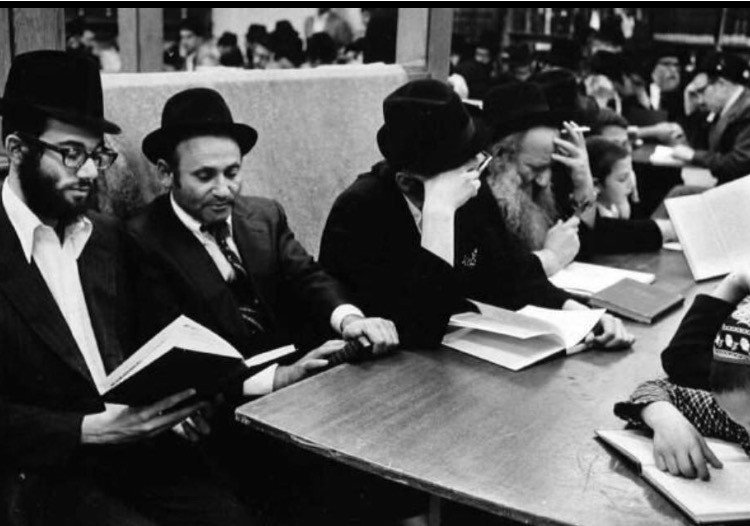
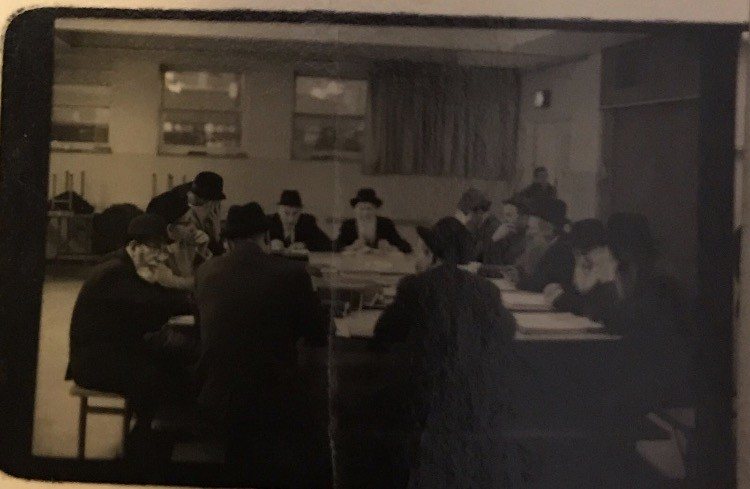
At the shiur.
The shiur changed lives. A Hungarian Jew who came early to shul on his yahrzeit, years after he had stopped coming, sat down by the shiur, came back every night, and built a home of Torah; in time he retired early to learn. His daughter married the son of another member of the shiur, and they became shluchim in Winnipeg. After the shiur, people poured out their hearts to Reb Avrohom, and he listened until they were comforted.
The recordings
One of the regulars, Reb Yitzchok Gneiwish, whose business took him around the world, asked him to record the shiur so travellers would not miss it. Reb Avrohom was reluctant, but agreed, and over seven and a half years all of Shas was recorded, about 2,700 cassettes. He re-recorded any shiur disturbed by noise or a misunderstanding, recorded Shabbos's daf separately, and bought the best cassettes with his own money. He gave them only to members of the shiur who had missed a day; when Torah libraries asked for the set he refused: "Es iz zicher do besser", there are surely better maggidei shiur.
His family later digitized every cassette, first for a telephone line and now for this website, so that today he teaches more people at once than he did in his lifetime.
The man
He had no wish for wealth or honor. A friend once begged to buy him the house he rented and let him repay without interest; he refused, unwilling to owe anyone. For years a talmid chochom broken by the Holocaust led the Seder at his table, and he gave him whatever he asked for. Each Shabbos there were guests at the Karp table.
At home he never raised his voice except to say "Zogt di Gemoro," and his children never heard money discussed. Once, deep in learning, he told his little daughter to say on the phone that he was not home; a few minutes later he found her crying, "How can I say a lie?" He spent days comforting her.
His final years
At 62 he was found to have a benign brain tumor. He wrote to the Rebbe asking where to have the surgery, and the Rebbe answered: "כעצת מורה הוראה בעירו", as the rov of his city advises. He was operated on in Montreal in 1984, and again in 1989. Radiation left his left side paralyzed, but not his speech, and he did not stop teaching. His wife moved the furniture out of the living room, brought in an aron kodesh and tables, and turned their home into a shul; from there he gave the shiur, and his voice carried to the yeshiva across the street. His neurosurgeon called him a living example of a man full of life, and brought his family to receive his bracha before Rosh Hashanah. When a television crew was called to interview him, he declined: "It's no honor for me to be on TV."
Only when his speech was finally affected did he stop, and that broke his heart. He spent his last ten months in hospital in New York, and his family never left him alone. Once, after months with his eyes nearly always closed, he opened them; his son asked, "Tatte, do you want to learn?" He nodded, and they learned a mishna together; when they reached a difficult din, he said it was a machlokes. Reb Avrohom was niftar on Yud-Tes Elul, 5758.
His legacy
Reb Avrohom was a Chossid, at home in the beis medrash of every Yid who learned. His life is a testimony of mesiras nefesh and perseverance, of hasmodoh, love of Torah, warmth, and chinuch. Had he been great in only one of these, he would be remembered as great; he was a giant in all of them, and each of us can find something in his life to bring into our own. This website is a tribute to Reb Avrohom and his wife Rivka, and to the shiur he gave every day for thirty years, which continues every day.
Photos
About this site
Every shiur of Rabbi Karp's Daf Yomi cycle, in Yiddish. Where available, the Gemara page follows along with the shiur, showing the part being discussed, with Rashi, Tosafos and an English translation alongside.
Gemara, Rashi and Tosafos text and the English translation come from Sefaria (William Davidson Talmud, CC BY-NC). Page scans: the Vilna Shas (Romm, 1880s), digitized by Duke University Libraries and the Internet Archive. Page layout: daf-renderer.